Showing posts with label simple living. Show all posts

Saturday, October 24, 2015

Fixing a Hole Where the Rain Gets In


Now that the windows were firmly in place, we fixed our cladding permanently. It looks like a simple job, but it took us days and days. Because our structure is transportable, we used screws to fix the cladding. Apparently, cheaper nails are used in conventional house builds.

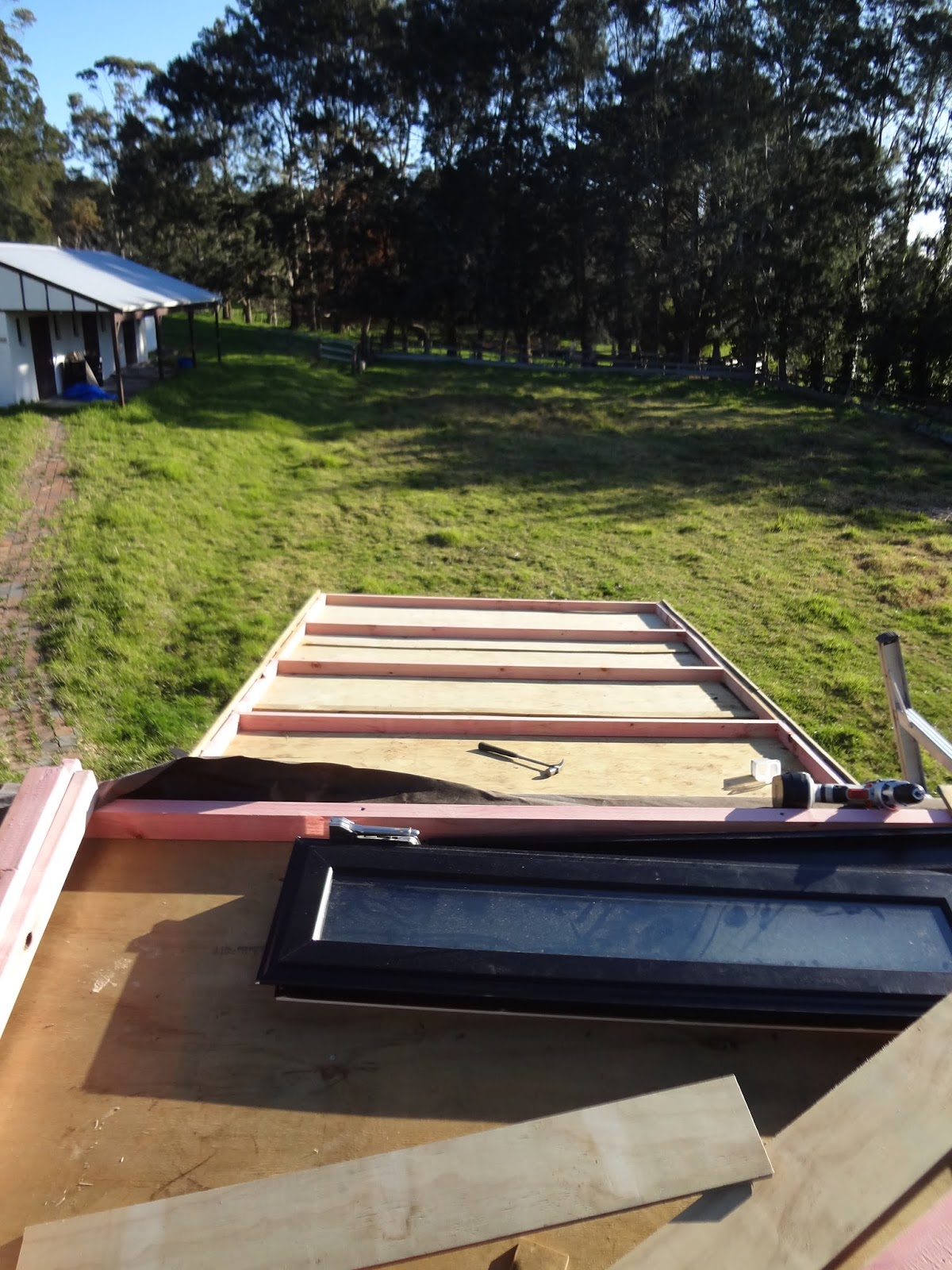
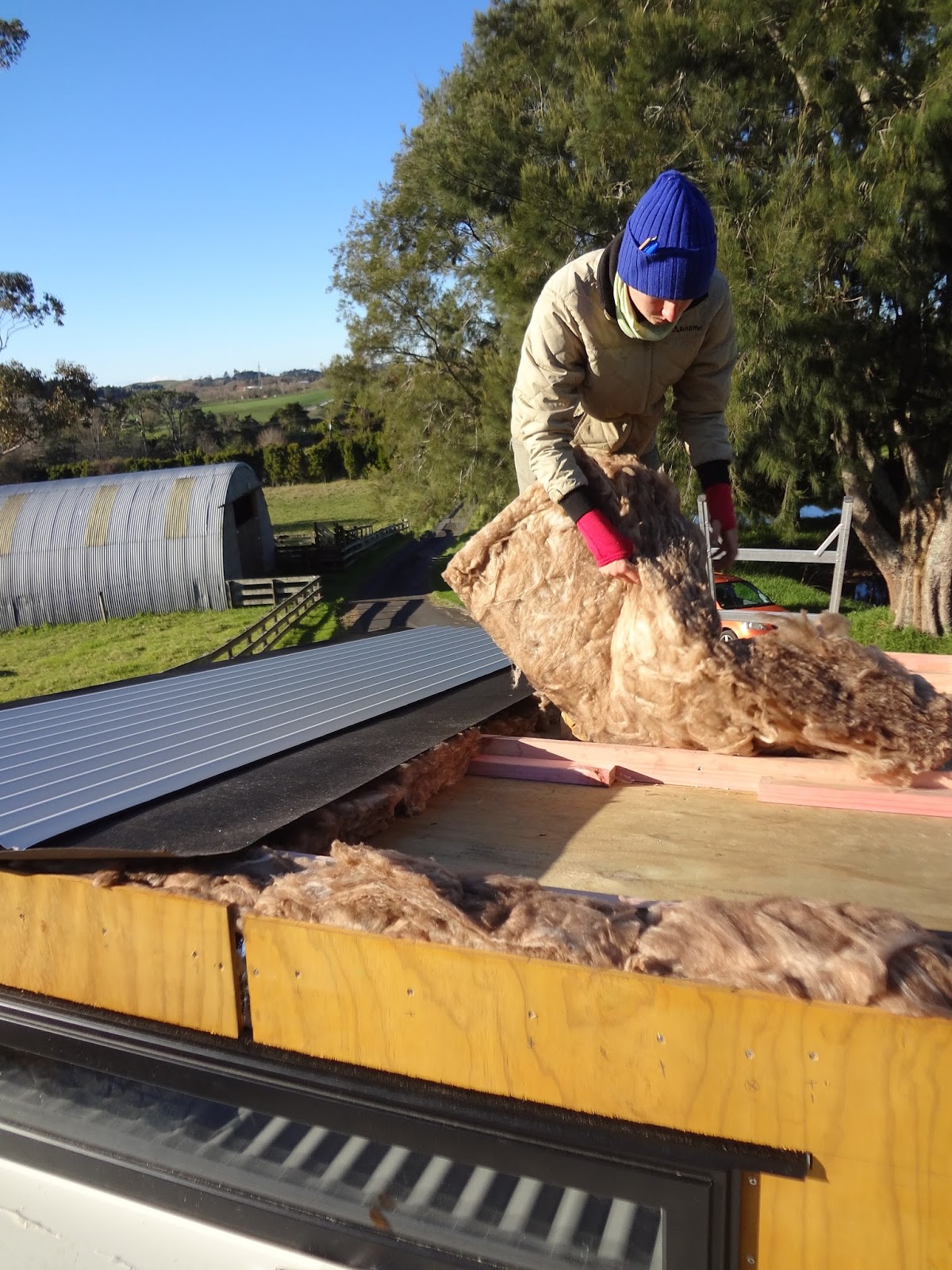
With walls on and a five-day clear spell on the way, we were ready to climb to greater heights: the roof! On top of our ply ceiling, we screwed down roof purlins to hold the insulation and also to give us something to screw our roofing iron into.

Steff: The days were unseasonably dry, but icy. For many days, I was stationed up on the roof, passing things back and forth. I had a great time contemplating the view and watching the long winter shadows travelling across the site, and it was nice to be outside in the sun, but not getting burned. This part of the build was undoubtedly exhausting, especially as I was using strange and unknown balancing muscles. I also found myself seriously dehydrated by the end of the first day with the cold, dry wind. Four metres up in the air is not where you want to have balance and cognition issues, so I made sure to bring plenty of water for everyone for the rest of the roof days. In between the flurries of activity, my time on the roof was very peaceful. 

Nancy: Being on the roof was by far the most terrifying part of the build for me. I'm not typically afraid of heights, but once the iron was in place, there was nothing to hold onto if one were to lose one's balance. I didn't like climbing the ladder to the roof, I didn't like leaning over the edge to fasten the iron in place with our roofing screws, and I especially didn't like trying to get back down again. The weather was lovely, and there were a few moments when I was far enough from the roof edges that I appreciated the tranquility and quiet (you couldn't hear anyone or anything down below from the rooftop). For the most part, though, I spent those five days tense and cranky, and with a heightened sense of self-preservation.

View from the top.  

Layers, right to left: ceiling insulation, building paper, iron to top the roof sandwich.

First roof, positioned and screwed down

A frosty start to day three

Steff positions the insulation

David stays safely on the ground. Note: aforementioned APRON flashing.


As the sun dipped behind these casuarina trees, it became intolerably cold.
We had to stop what we were doing immediately before we lost our heads and our dexterity to the chill.

The team hard at work

David doesn't like ladders either

The roof needed to be swept to remove any shrapnel that may have burst forth from the iron
while it was being screwed down. Barge flashings are now in place

We brought our builder friend back in to teach us how to put the first roof in place, and he left us to our own devices to complete the project. Due to a fear-induced measurement miscalculation and cumulative error, our second roof is now on very slightly askew. Our friend, when he came back to check it for us, described it as "a bit on the piss, but watertight".

Watertight. After months of battling the elements, tarpaulins blowing rampant in winter storms, waiting on overdue windows, and watching as torrents of water streamed onto months of hard work, we were enclosed and dry. This was a major achievement for us, and cleanly closed a chapter of the build.


From now almost until the end, we'll be inside.


Creative Commons License
The Quest Quotient by Nancy Howie and Steff Werman is licensed under a Creative Commons Attribution-NonCommercial-NoDerivs 3.0 Unported License.
Based on a work at thequestquotient2011.blogspot.com.

Friday, April 17, 2015

Absolute Beginners

Hold the phone, though. We're ploughing right ahead on the assumption that everybody knows what a tiny house is, and that may not be the case. Let's start there: what is a tiny house?

Quite simply, a tiny house is a really scaled down home. Technically, the term could be used to describe any diminutive house, but the tiny house we're referring to is built directly onto a trailer. This means you can move your home if you have to relocate. Tiny houses typically have a small bathroom, kitchen, living area, and a sleeping loft bedroom.

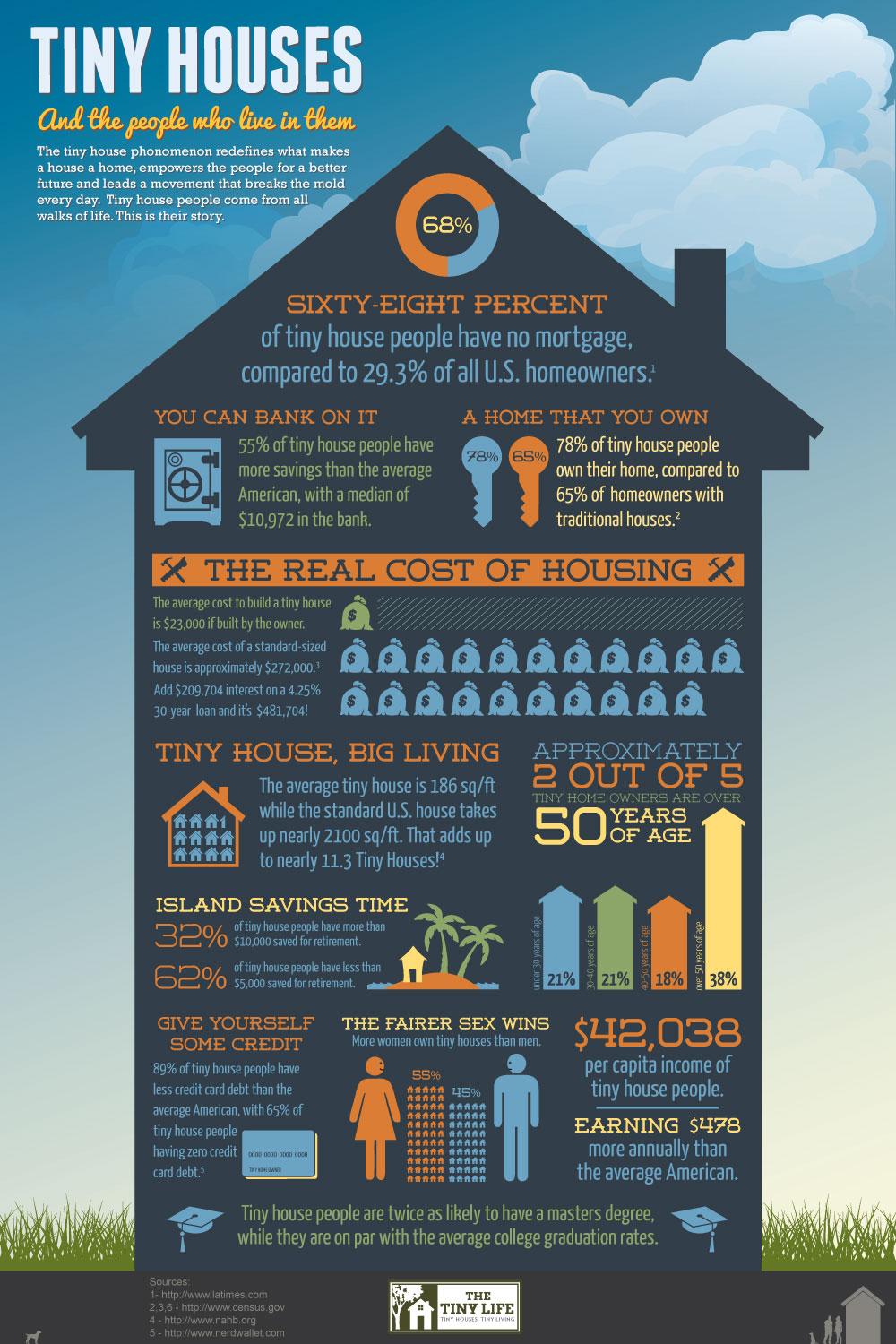
Living in tiny homes is fast becoming a movement, a reaction against McMansions, against consumerism, against mortgages. For a generation not expecting to ever be able to own homes, tiny houses provide a loophole—they are far less expensive to build than a conventional home, and their size necessitates a simpler lifestyle, as there isn't the physical space to pile up the possessions. In indirect ways, living in a tiny house gives the home-owner more time and freedom, and reduces their overall impact on the planet. And for those who choose to self-build, as we are doing, it represents the reacquisition of skills we seem to have lost as a population—building our own shelter. 

Here's a little infographic on the subject:  


Alternative housing had always piqued our interest. Hours had gone into researching Earthships, houseboats, cob and strawbale homes, and yurts. Tiny houses, though, seemed immediately like the best fit at this stage in our lives. From our urban apartment, we looked into a number of different houses that had been built by others the world over, on blogs, and video webseries, like Kirsten Dirsken's . These were some of our favourite abodes:

We had our sights set on buying plans from a local designer, not only to help support the local economy, but also because we didn't want to be having to make conversions from imperial to metric (what's up, America? Metric's so easy!)--at this point, we ran into Brett Sutherland's tiny house video tour. 


Not only was Brett local to us, his house was spectacular! The tiny house community seems to be really hooked on gabled roofs, which we found a bit claustrophobic. Here was a house that had its roof space opened right up, leaving ample breathing room in the living area, and plenty of sitting space in the loft. Brett had built the boat he had lived on prior to returning to land, so he had experience in smart design of small spaces. Not wanting to buy sight unseen, we contacted Brett to see if we could visit his house.

NANCY: I have to admit that I was a bit nervous that we'd get to his house and find it suffocatingly narrow. Upon entering the space, however, I fell in love. I was basically inside a boat. Having grown up on sailboats, I instantly felt like I was home. I was ecstatic. We bought the plans on the spot.

STEFF: What a lot of people don't realise about tiny houses, having only seen pictures of them, is that when you're inside the space, it feels plenty big enough. Also, we have a really mild climate in Auckland, and Brett's design allowed for a lot of cross breezes and indoor-outdoor living, as well as for easy catching of rainwater. It was the ideal plan for our build.

This brought us to our next question: how does one actually build a tiny house? To be honest, we had no idea. We had never built anything before. That's not entirely true; we tried to build a wall in New Jersey once, and we almost got divorced over it. But after some consultation with Warren, our extremely tolerant and endlessly valuable builder friend, we were advised to take everything one step at a time. We made a start: we ordered the trailer.

The trailer is the single most expensive component of the build, checking in at approximately $10k. Putting the deposit on our custom trailer, then, was the point where this tiny house whimsy started to become a reality. We chose to buy our trailer from Monoway, having heard good things about them. Their trailer was not only strong and nicely galvanised; they had also positioned the support bars so that our plywood flooring slotted perfectly into place (no trimming necessary, except around the wheel arches).

Also significant for us was moving out of our apartment. We had tried to work out a way to continue living in the city and building part-time, but that would involve a regular commute to our build site, in addition to continuing to pay rent.

NANCY: Having begun our build, I'm so glad that we made the decision to move out, if only because it makes funding the house so much less of a stress, not having the constant threat of rent hanging over our heads. Also, it's so nice to be able to finish a day's building and have a shower straight away. The commute into work is no fun, as Auckland traffic is steadily worsening, but it's a small sacrifice, when put in perspective.

STEFF: Living with family presents its challenges, but it's actually really nice to come home to an intergenerational household. Moving back in with family has immediately increased all of our support networks.

Our last step before trailer delivery was to do a massive shopping trip for the first stage of the build. We bought what came to look like a large heap of plywood, planks of framing timber, and a box of fixings. A few days later, our trailer arrived, and we began:

Levelling the trailer using cinder blocks and ground-treated timber.
The timber is there to spread the weight of the house;
it is ground-treated to prevent it from rotting in the wet conditions.

Creating a vapour barrier between the trailer and the plywood flooring

Destroying a perfectly good pair of scissors with bitumen

Drilling through ply and metal, countersinking, and driving tech screws to fix ply floor to trailer

Sanding off builders' bog, which we used to fill the countersink holes. Also, a bovine photobomb.

This week, during our ongoing process of downsizing belongings, we found this postcard that we sent ourselves from New York, in 2011. Our pertinent past selves just nailed it.

"Hey, Nancy and Steff! By the time you receive this, you'll be home!
Here's something you learned on this trip; don't forget it: so many people, at the end of your trip
brought attention to the fact that the trip was long, arduous, dangerous;
"how did you do it?!" they'd ask. Here's how: you just went ahead and did it.
Remember this for goals you might want to achieve in the future--just go ahead and do it!
Love, Nancy and Steff"


Creative Commons License
The Quest Quotient by Nancy Howie and Steff Werman is licensed under a Creative Commons Attribution-NonCommercial-NoDerivs 3.0 Unported License.
Based on a work at thequestquotient2011.blogspot.com.

Tuesday, October 4, 2011

Money, Money, Money


Believe it or not, it’s coming up to our eighth month on the road. And all along the way, people have asked us how we can afford to do this trip in the middle of a recession. We’ve decided to include a special topic blog, just for you, readers. Here we go: this one’s about frugality in transit.
Firstly, let us emphasise that we do not generate money using crime, ingenuity, or magic. In fact, we are not generating money at all at present. The truth is that we worked our butts off last year in preparation for this trip and are making it last in a variety of simple ways.
Accommodation Costs
Before we left, we calculated the cost of staying in hotels. Horrified, we looked into the cost of staying in hostels. Horrified, we bought a van with a foldout bed. 
Having our home on our backs while traveling has enabled us to stay months longer than we would have, had we been forced to pay for our accommodation along the way.  
As you know, the WWOOFing component of the trip is over. While WWOOFing was almost completely free (and thus an excellent way for travelers on a budget to explore unseen lands), we’ve been fortunate enough to have a safe place to stay almost every night since then. We both have many friends and family members living in North America (a crucial factor for us in deciding just where to go). Not all of our hosts have have had guest bedrooms, but we tell them it’s no problem. “We’ve brought our own!”
Facebook, surprisingly, has been a useful resource for finding a place to crash. We have met a good many people after posting the status update: “Ahoy, friends! Does anybody know anyone in _______ who we could stay with? All we need is a driveway and a toilet!” People we have stayed with have also, helpfully, gotten in touch with friends of theirs to help us find places to stay. Then, if none of these options work out, as a last resort, we stealth camp.


It turns out that graveyards aren't the best places to stealth camp. Despite the fact that this one had its own port-a-loo, we found ourselves awake at 2 a.m., anticipating a Living Dead-style ordeal. 

Stealth camping is a fine art, one that we have slowly honed since White Rock, B.C. Essentially, stealth camping involves pulling surreptitiously into an area to sleep, and slipping away unnoticed in the morning. Many websites recommend arriving at your stealth destination late and leaving early. There are merits to this method, but there are also challenges. For example, it is difficult to get a feel for a neighbourhood when it is dark. What we prefer to do is to scope out an area before dark, locate the perfect spot, then find a large, nearby parking lot (ie. for a mall or a supermarket). We park in the lot, cook dinner, and use the bathroom just before the store’s closing time. Then, when darkness falls, we return to our selected sleeping place. The ideal sleeping location is a quiet, suburban family neighbourhood. We look for bicycles, toys in yards, expensive cars, or families out walking their dogs as a marker of suitability. Optimally, the chosen location is also close to a shopping centre, which you can visit in the morning to use the facilities before departure (as much as we despise Walmart and McDonald’s, these are the most likely to be open 24 hours, in case nature makes an inconvenient house call at 3 a.m.).

Feeding Ourselves


Crazy potatoes!
Continuing with our theme of convenience, humans, most inconveniently, require constant feeding.
This was initially a challenge for us, as we discovered soon after our arrival that VW Westy fridges rarely work. Ours may work, but nobody thus far has been able to figure it out. Instead, we use a chilly bin (a “cooler”, for our North American readership), and our fridge as a dry storage area. Ice for the chilly bin can typically be found for free at marinas. Failing this, we have saved large juice bottles, which we fill with water and store in people’s freezers when we visit. We have yet to stay with anyone who has refused to let us freeze our “ice cubes” in their freezer. But if we’re desperate, ice is sold relatively cheaply at most supermarkets and gas stations.
Having a cooler means that we can consume a few perishable foods, like yoghurt, cheese, eggs, and milk. Because vegetables don’t keep long in the cooler, we typically buy them fresh every few days. Preferably, we stop at farm stalls and farmers’ markets along the way, to buy local produce direct from the farmers. We also keep what we feel is an admirable store of non-perishable foods, like pasta, brown rice, canned fish and beans, dried mushrooms and wakame, and dry pulses (a nutritious and delicious source of protein when meat is difficult to keep). We have garlic--clearly, we weren’t about to go ten months without garlic!--onions, and a variety of spices to make our meals interesting. We’re literally ready for the zombie apocalypse. Most of our main meals involve either potatoes, rice, or pasta with an elaborate veggie stir fry, beans or eggs. We typically make enough dinner so that we have leftovers for lunch for the next day.


Guacamole! Avocado, garlic, onion, lime. Poignant. Simple. Delicious.

Breakfast is a nice, simple meal for us. We make our own granola, in vast quantities. Here’s how we do it:
Ingredients:
-rolled oats 
-a variety of seeds (sunflower, pumpkin, sesame, poppy, and flax)
-nuts (almonds, walnuts or pecans, macadamia nuts, and hazelnuts)
-chopped dried fruit
-oil (we’re indiscriminate. We used olive oil last time, and that worked really well)
-honey or molasses
-cinnamon
 We like to buy our nuts, oats, fruit and seeds from the bulk bin section of a supermarket. We opt for whatever’s fresh, because often bulk-bin supermarket nuts are rancid. Steff can attest to this, being our official taster. Anyway, on with the show.
Method:
Coat oats in a generous amount of oil (but not so much that there’s excess at the bottom of your mixing bowl). Toast oats until lightly browned. This can be done in the oven or in a skillet. Put to one side. Toast nuts and seeds until lightly browned. Set to one side. Mix and gently heat oil, honey/molasses, and cinnamon in a pot, and add to the nut and seed mixture. Make sure the nuts and seeds are properly coated in the honey/oil/cinnamon mix. Combine browned nuts and seeds with toasted oats. Add chopped dried fruit. Store in a cool, dry place (like what used to be a refrigerator).


Tadaa!

The ratio of oats to nuts is up to you. We like to a 60/40 oats to nuts mix, because nuts can get quite expensive.  We calculated, however, that our granola comes out at about $0.80 (USD) per serving (and our portions are generous!). A bowl of our granola keeps us fuller for longer, is far cheaper than the fancy-schmancy store-bought brands, and is customised.
Snack foods were something we had to deal with from the get-go. Our maiden voyage was a bit of a disaster, in retrospect. We stocked up on gummy bears and root beer, and were fairly sick about an hour in. Yes, we reasoned afterwards, we’re on a road trip, but it’s a ten-month road trip, and we can’t justify snacking on junk food for that long. So we started to make our own snack foods. Nuts and fresh fruit are excellent road snacks, but one of our favourites is homemade salsa. Behold:
Ingredients:
-3 tomatoes
-half a brown onion
-juice of one lime
-2-3 cloves of garlic (more if you’re Steff)
-a generous bunch of coriander/cilantro
-salt and pepper to taste.
Method:
Mince everything that can be minced. Mix in everything else.


It’s delightful with organic blue corn chips. It’s also a great sauce for cooked dinner meals and for huevos rancheros.
At the start of our trip, someone advised us to eat out on the grounds that it would be cheaper. Firstly, it’s definitely not cheaper to eat out--cooking from scratch generates meals that rarely cost over $2 per serving. Most importantly, though, we do not cut corners when it comes to food. We certainly aren’t frivolous in our food spending, but our policy at home has always been to pay now for healthy food rather than pay later in medical bills, and it still applies while we’re traveling. Sure, processed food and conventionally-farmed fresh produce is often cheaper, but we’d prefer not to contaminate our bodies with growth hormones, antibiotics, high-fructose corn syrup (or whatever they’re calling it now), or anything else in that vast array of unidentifiable food chemicals. While we’d prefer to be growing our own, it’s difficult to keep a garden in a van. We do, however, grow fresh sprouts. We’re told they’re uber-nutritious. They’re also tasty in sandwiches, stir-fries, and salads. We can’t grow much else in the van, but we’re willing to pay for the next best thing, which is organic supermarket food, or produce bought from organic farmers. 
Entertainment
Obviously, this trip hasn’t been all sleeping and eating. We have entertained ourselves besides. Entertainment can be expensive, but it doesn’t necessarily need to be. 

Steff entertains herself in New Hampshire. Ride, Sally, ride!

When we arrive in a new area, the first thing we do is go for a walk (don’t worry, it gets better!). On our way, we usually come across local papers, which list events, like poetry slams, lectures at universities in the area, or local live music. These are often free or very cheap.
Yelp.com has been an excellent resource for us (thanks to Nancy’s uncle Wes for introducing us to the website). For those of you who aren’t familiar, Yelp is a site on which you can search within a town or a city for anything you might be looking for, be it a VW mechanic, an Ethopian restaurant, good espresso, or, in this case, “fun things to do”. The site lists items according to your search criteria in order of ranking by other users. It also features reviews, again by other users. We have found some true gems through Yelp.

Seeing the sights (famous landmarks, churches, city halls, libraries, etc.) rarely costs money and makes fabulous photo fodder. Museums are often free. If not, many have free days or a suggested donation (read: they’re free). All of this information is on the Internet.


Here are some sights we have seen along the way:


Sanders Theatre at Harvard University. Thanks, Deva, for smuggling us into your class!


Steff outside the Basilique Notre-Dame de Montreal
Horseshoe Canyon, Alberta. This tour courtesy of close family friend Janice!


Chain bookstores have provided us with warmth and outlets to charge our phone/iPod/camera batteries. Almost every mall in North America has a big box bookstore, and almost every one of these bookstores has a (Starbucks) cafe, where you can sit and read the books to your heart’s content. Or at least, until you’re kicked out at closing time (as a side note, Starbucks has free internet. As there are usually two to three of the "cafes" on any given city block, we have never had to pay for Internet on the trip).


This, predictably, leads us to books. Secondhand books are unbelievably, irresistably cheap here (we bought twenty books for $5 at a Las Vegas Library book sale back in March). We realised that having free time for the first time in years has afforded us the perfect opportunity to sit down and read books. How many times last year did we find ourselves complaining about not having time for leisure reading? Cheap books are ubiquitous--we like to check out secondhand book stores, garage sales, flea markets, and libraries (which also have free wifi--bonus!). 
If you’re traveling in summer, look out for music festivals, because they take volunteers. At the Vancouver Island MusicFest, we got a weekend pass for the festival (including the Thurs. night pre-show), free meals, and free camping in exchange for a mere 18 hours of labour in the volunteer kitchen (spread over the three days). This was without question, the best free fun we’ve had on the trip!


It's nice to have a quiet day in after days of driving. 
The aforementioned are all fun, but by and far the greatest source of entertainment is the people we meet on the way. One can plan a trip meticulously with sightseeing and tours, but we’d rather plan our stays with people and leave the rest of our time open. Our best times have been unplanned experiences with other people. Essentially, rather than spending money to get to know a place, we’d prefer to get to know the people. 


Plus, most people are happy to show visitors around their town and the surrounding areas. They also have an insider’s perspective on fun activities for their town. As house guests, our hosts have taken us on walks and hikes, to farmers’ markets and flea markets, to college reunion parties, on driving city tours, to dinosaur museums, and to friends’ homes for dinner. 


Hoodoo? You do! Do what? Remind me of the babe!


Downtown Calgary. Thanks, Ennio and Briana for the tour!


Steff and a dinosaur leg


Lastly, having a couple of guitars and a repertoire of well-known songs has not only been a free source of entertainment for us--it has gotten us through several open mics that others have invited us to. We’ve also met a diverse range of people through our music.


Our first open mic night! 

Movin’ Around
Transportation is the last item we’d like to address. We have found that owning the van has served us well. We did look into Amtrak and Greyhound before we left for North America. The former has limited lines, which would have made travel to small, remote farms extremely difficult; the latter...well, it’s Greyhound. The van was really the best option for us.
That said, it’s important to monitor one’s fuel efficiency when traveling long distances. For an old gal like our Willie Westy, it’s essential that we keep her well-lubricated: we check her oil before every voyage. We also make sure to check the tyre pressure. Having well-maintained and properly-filled tyres increases fuel efficiency (read: saves money on gas) and improves overall handling of the vehicle. We’d like to thank Phil Patch for his help with our tyres in Minnesota--we’ve really noticed the difference! Lastly, it’s good for the gas mileage (and the brakes) to avoid rapid acceleration and deceleration. Granted, rapid acceleration has never been an option for Willie, but we try to drive her steadily and not too hard. We give her regular breaks and try to keep an even speed throughout. And of course, we thank her after every trip.
Closing Words
Living in the van has taught us valuable lessons in the difference between luxury and necessity. It has been a pertinent introduction to a simple-living lifestyle. It is so important, especially in light of the recession, to be able to accurately evaluate what one needs versus what one wants. There’s nothing like living in a 7’ by 4’ by 10’ van to make this devastatingly clear. We do not shop recreationally on this trip, not simply because of the financial factor, by also because there would be nowhere to store our goods once we brought them back to the van. When we need new clothes, we make sure to donate some of the old ones, and we always replace them at thrift stores. It appears that North Americans are far more likely to ditch good clothes at Goodwill or the Salvation Army than Kiwis. Many of the items we’ve found are brand new (as opposed to Hospice Shop clothes, which have often been worn to well-loved, holey rags).

The butterfly garden at Calgary Zoo. Saving money in some areas allows us to spend it on things we really want to see or do. Like go to the zoo!


When we describe our trip to others, their first reaction is shock at the imagined costs involved. Many people have asked us about our budget along the way. When we left New Zealand, we were aiming for an average daily budget of USD$30 each. Factoring in our time WWOOFing in Canada, we’re currently well under-budget. Hopefully, with a little sensibility and resourcefulness, we’ll be able to keep up this trend. 

Do any of the readers out there have any pointers they'd like to add? If anybody has any questions, feel free to use the comment section below, and we’ll answer to the best of our abilities! 


Sundown at the cemetery


Creative Commons License
The Quest Quotient by Nancy Howie and Steff Werman is licensed under a Creative Commons Attribution-NonCommercial-NoDerivs 3.0 Unported License.
Based on a work at thequestquotient2011.blogspot.com.

Monday, August 22, 2011

Golden Years


This photo and many others in this entry by Agathe Duault

Now for the hippies.

N: When I was twelve, I told my parents that I wanted to live in a VW bus in a communal living arrangement. I probably took this claim about as seriously as my skeptical parents, because I was shocked to discover that my preadolescent desires were to foreshadow great things to come. 


Enter Golden Ears Community Farm
Here's how it works: there are ten under-30s. They work the land and sell their produce at local markets and at their fruit stand. The profits are divided between the ten. Their work is aided by interns and WWOOFers (that's us!).


The property is essentially twenty-something acres of edible crops, including, but not limited to: strawberries, apples, blackcurrants, pears, cherries, garlic, onion, kale, lettuce, swiss chard (aka silverbeet), radishes, yellow and red beetroot, potatoes, four varieties of raspberry, peas, beans, cucumber, squash, pumpkin, corn, basil, tomatoes, broccoli, and medicinal and tea herbs.


There is a market garden, and a kitchen garden for personal consumption. The members ordered in their grains, spices, and nuts--virtually everything else in their diet is sourced on the farm. Win!

The clan settles down to a homegrown banquet.

Golden Ears has a humanure composting toilet system and a long drop, affectionately christened the "Poo with a View".


The view of the river

"Support Our Poops!"

There is a river that runs adjacent to the farm (which makes up the aforementioned view). Nancy found it intolerably cold, but then, as we all know, her thermostat is broken. Steff cheerfully took her kit off and jumped in with everyone else at least twice daily to cool off and remove the top layer of encrusted dirt. There was, in fact, such a constant stream of naked youths crossing the road to the river at any given time that we wanted to change the "LIVESTOCK CROSSING" sign to "NUDIST HIPPIE CROSSING".

The wild roaming chickens!

Friendly household pigs!

In addition to profits earned from their food, the farm has a bike stand, which is run very efficiently by two cycling enthusiasts from Alberta. Bikes are repaired, rebuilt, and custom-made for clients. The bike whisperers also collect broken, dilapidated, or unwanted bicycles and restore them to their full health.

There you have it: Golden Ears Farm. It was here, in Chase, BC, alongside Shuswap Lake, that we WWOOFed from late July through to mid-August.

What Did You Do There?
We picked raspberries.

It's like a jungle sometimes; it makes me wonder how I keep from goin' under...

We did some other stuff, sure. For instance, we made fresh mozzarella cheese and peach jam, processed garlic, weeded strawberries, picked peas, and painted a door. We even experimented with cooking for a household of sixteen. And, of course, we swam in the river--one day, Nancy was so brave as to go in as deep as her knees!

Nancy proudly displays fresh mozzarella!

Steff works on a knitting project with the help of Starshine, resident stray.

The completed (but unmounted) door

But before, in between, and after these activities, we picked raspberries.

Steff wields her battle scars from raspberry picking.

The work day begins at 6:30 am, with breakfast at around 8, lunch at noon, and dinner at 6 pm. Meals are shared in the main house, and individuals sign up for weekly cooking and cleaning duties on a giant blackboard. WWOOFers are expected to work five to six hours a day, six days a week.

What Did You Feel There?
"Overwhelmed" is probably the best descriptor to go with here, at least at first. It was akin to the first day of school, entering a pre-established social system, not knowing a soul, and trying desperately to get to know everyone. And this was an "everyone" that had been living together in the same house for at least a year.


We suppose that if we had to sum up our experience of Golden Ears into a life lesson, it would be that communication is key. Our stay at the farm was more about learning to live harmoniously with others than it was about raspberries, believe it or not. With a densely interwoven and hugely complex network of interrelationships to decipher, not to mention the challenge of coming to understand the ten to fifteen individuals (the number of residents fluctuated), our stay at Golden Ears was an intensely emotional and educational experience.

Steff consumes Gaia's Garden.

It is a given that there will be miscommunications in a community of so many people. We often found that we were given at least ten different sets of instructions for a given task. And naively, we thought that it would be easy to share the same space as a small horde of people; after all, we both have some experience in waiting for siblings and flatmates to get out of the bathroom. Oddly enough, it so happens that waiting behind fifteen people in the long drop line-up after a hearty meal of baked beans is another matter entirely.

Preliminary sketches for the door painting

No, it wasn't easy, but it was certainly rewarding. We met a motley crew of fascinating characters. There were people who sang Simon and Garfunkel's "Cecilia" to the point that it was causing mental instability in everyone else, and some who routinely hoed in the nude. We met people who traveled everywhere at a sprint. There were those who craved daily routine and others who relished spontenaiety, people who loved to produce gourmet meals and others who would prefer to wash every dish in the house than cook a meal themselves. There were rabid permaculturalists, chicken enthusiasts, avid nudists, and candidly honest, sensitive individuals. In the words of The Small Faces, it was "all too beautiful".

Happy 21st Birthday, Agathe!

Meta-WWOOFing
While at Golden Ears, five of us were loaned out to another farm, two hours away. Matty, one of the five chosen ones, leapt at the opportunity to spend time at Mendel and Paula's quiet sanctuary. Little did he realize that bringing four girls along would invalidate all and any claims on silence. We planted lettuce and thinned carrots during our two-day stint at Mendel's farm. Over that period, we simultaneously got to know each other very well and drove Matty to the brink of breakdown. On the last morning, Matty rose at six in order to get in a few hours of work in peace.

Mendel was a genial, crazy sexagenarian with a heart of gold, and his 110-odd acres were spectacular. See for yourself:

Weeding cabbage 

Lettuce, tomatoes, carrots...

In addition, Mendel had a recording studio and held regular jam sessions with his two sons, also musicians. One afternoon, Steff stepped up to the mic to take on lead vocals, Nancy jumped on piano, Matty banged on bongos, Agathe and Georgia played percussion, and Mendel and sons made up a hearty rhythm section. A great musical jamboree was enjoyed by all.

Mendel himself, rocking out to Arlo Guthrie's "Comin' Into Los Angeles"

Nancy on piano

Steff belts out CCR's "Proud Mary".

"Cecilia, you're breaking my heart..."

Mendel taught us the two fundamental lessons of Canadian farming, and we now pass them on to you, readers, in the interest of broadening your educational horizons:
1. Swear a lot (ie. "F---, I just ripped out thirty carrots!")
2. Work faster, winter's coming!

On the way back from Mendel's, we stopped in Kamloops. We found the local travel agency offering a "Great Escape to New Zealand". Here, Nancy points out to Georgia where we live. And went to school. And where all our friends live. And our families. 

The Prom
Allegedly, there are a great many Vietnam War draft evaders still residing in the Shuswap area. These artful dodgers, many having missed their proms as youths, now hold an annual Hippie Prom, which we, of course, attended.

Note: In another version of the story, it was once a harvest festival, in which those in attendance shared and showed off their annual harvest of the non-edible variety. There were certainly traces of such a history at this prom.

And so, to culminate our stay, we kicked up our heels with a hallful of immaculately tuxedoed and prom-dressed hippies of all ages. Here we are, getting ready for the prom:

Don't we clean up nice?

We had to borrow dresses. Fancy clothes don't fit in our humble van.


On our last evening, the co-op road-tripped to Armstrong with us to see an outdoor production of A Midsummer Night's Dream. After the show, everyone bid us farewell and returned to the farm, while we slept in the fields behind the theatre. In the morning, we awoke to find ourselves, surreally, in an empty meadow, miles from the farm and our new friends.


And much like the characters in the Shakespearean comedy we'd seen the night before, we had trouble separating whirlwind dream from reality...

Ella the dog, guardian of the gates of Golden Ears Community Farm,

Many thanks to Agathe who took some of the photos which we included in this entry. Here is a portrait for you!


Creative Commons License
The Quest Quotient by Nancy Howie and Steff Werman is licensed under a Creative Commons Attribution-NonCommercial-NoDerivs 3.0 Unported License.
Based on a work at thequestquotient2011.blogspot.com.