Showing posts with label downsize. Show all posts

Saturday, October 24, 2015

Fixing a Hole Where the Rain Gets In


Now that the windows were firmly in place, we fixed our cladding permanently. It looks like a simple job, but it took us days and days. Because our structure is transportable, we used screws to fix the cladding. Apparently, cheaper nails are used in conventional house builds.

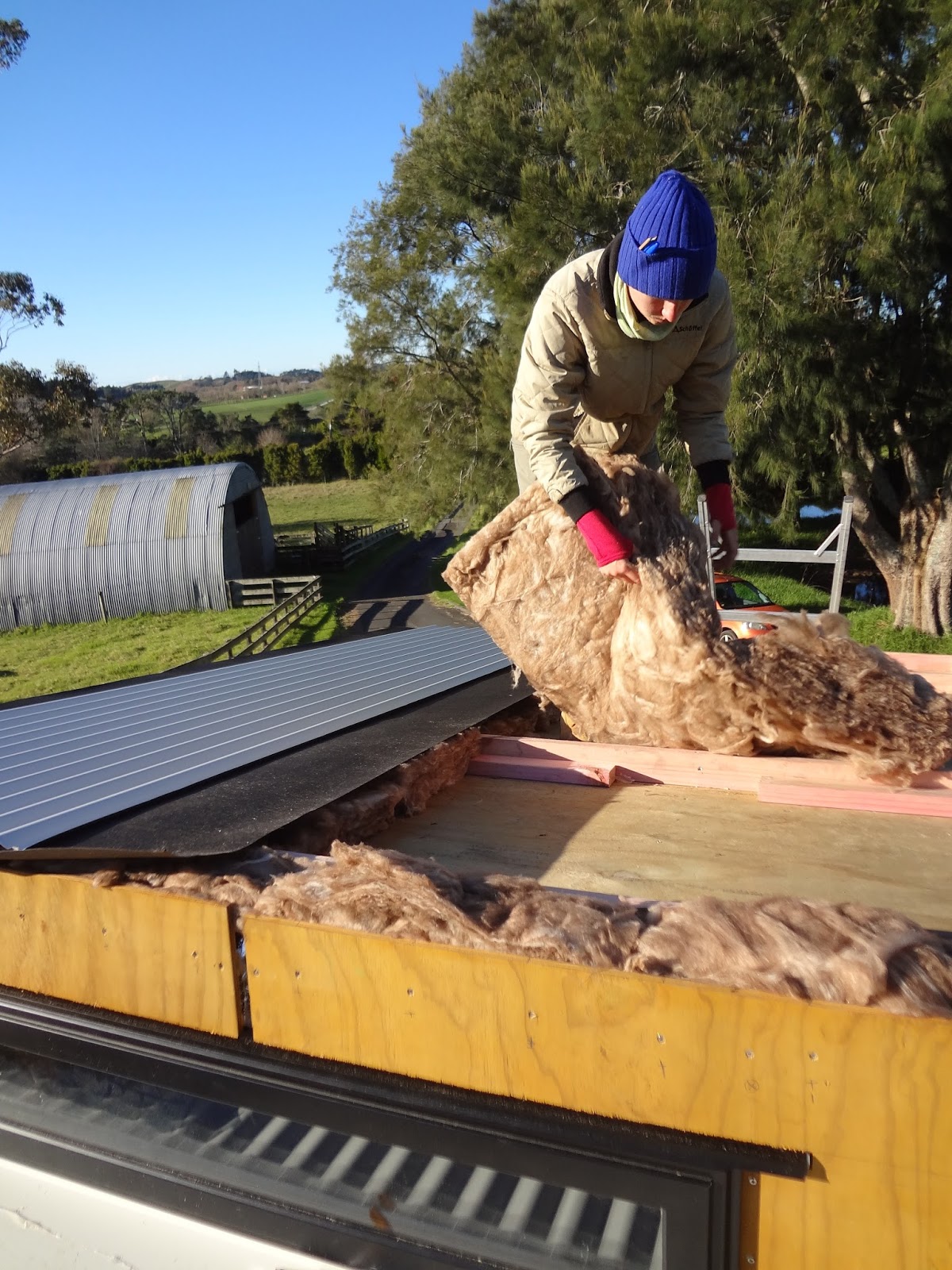
With walls on and a five-day clear spell on the way, we were ready to climb to greater heights: the roof! On top of our ply ceiling, we screwed down roof purlins to hold the insulation and also to give us something to screw our roofing iron into.

Steff: The days were unseasonably dry, but icy. For many days, I was stationed up on the roof, passing things back and forth. I had a great time contemplating the view and watching the long winter shadows travelling across the site, and it was nice to be outside in the sun, but not getting burned. This part of the build was undoubtedly exhausting, especially as I was using strange and unknown balancing muscles. I also found myself seriously dehydrated by the end of the first day with the cold, dry wind. Four metres up in the air is not where you want to have balance and cognition issues, so I made sure to bring plenty of water for everyone for the rest of the roof days. In between the flurries of activity, my time on the roof was very peaceful. 

Nancy: Being on the roof was by far the most terrifying part of the build for me. I'm not typically afraid of heights, but once the iron was in place, there was nothing to hold onto if one were to lose one's balance. I didn't like climbing the ladder to the roof, I didn't like leaning over the edge to fasten the iron in place with our roofing screws, and I especially didn't like trying to get back down again. The weather was lovely, and there were a few moments when I was far enough from the roof edges that I appreciated the tranquility and quiet (you couldn't hear anyone or anything down below from the rooftop). For the most part, though, I spent those five days tense and cranky, and with a heightened sense of self-preservation.
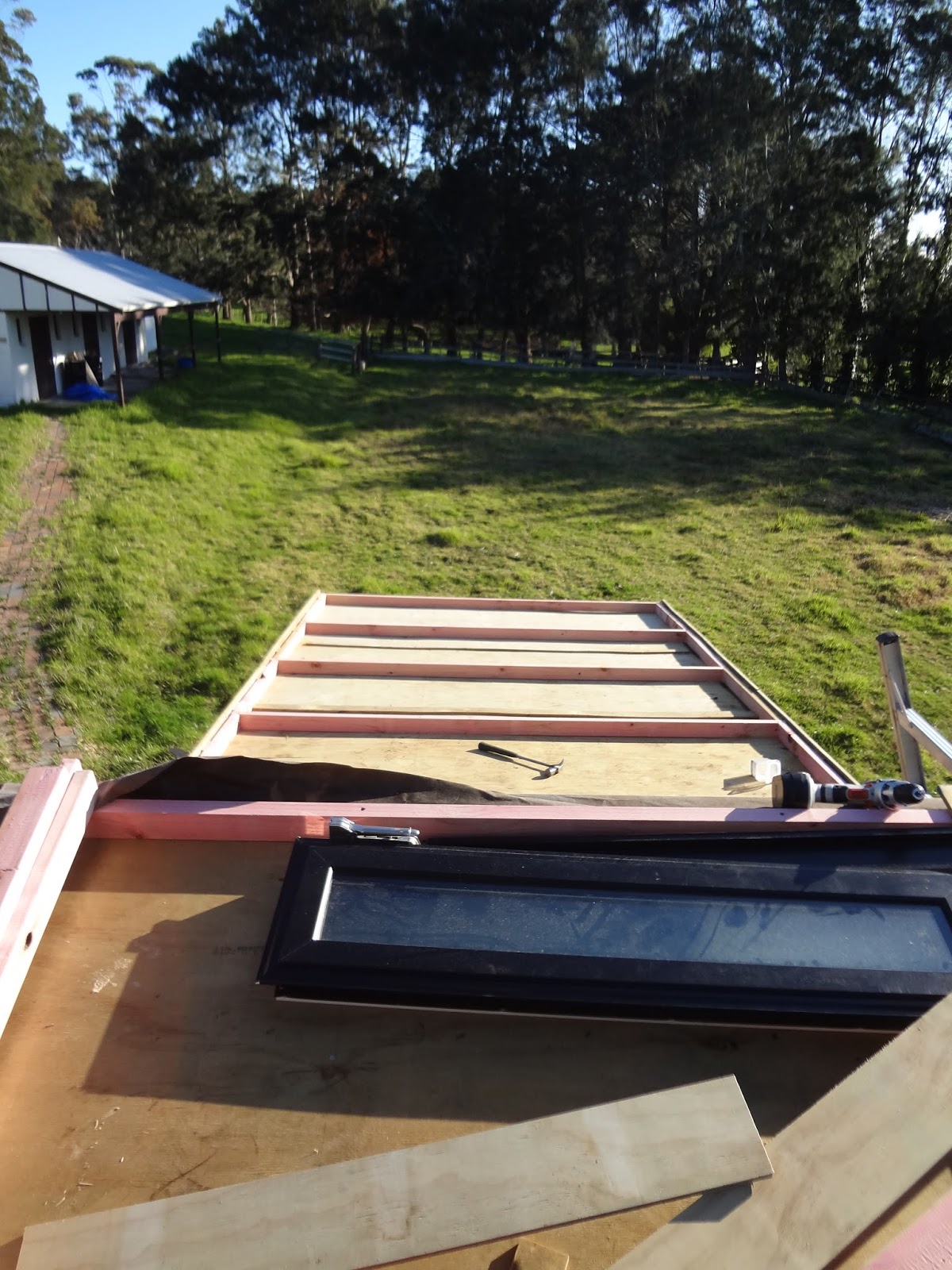
View from the top.  

Layers, right to left: ceiling insulation, building paper, iron to top the roof sandwich.

First roof, positioned and screwed down

A frosty start to day three

Steff positions the insulation

David stays safely on the ground. Note: aforementioned APRON flashing.


As the sun dipped behind these casuarina trees, it became intolerably cold.
We had to stop what we were doing immediately before we lost our heads and our dexterity to the chill.

The team hard at work

David doesn't like ladders either

The roof needed to be swept to remove any shrapnel that may have burst forth from the iron
while it was being screwed down. Barge flashings are now in place

We brought our builder friend back in to teach us how to put the first roof in place, and he left us to our own devices to complete the project. Due to a fear-induced measurement miscalculation and cumulative error, our second roof is now on very slightly askew. Our friend, when he came back to check it for us, described it as "a bit on the piss, but watertight".

Watertight. After months of battling the elements, tarpaulins blowing rampant in winter storms, waiting on overdue windows, and watching as torrents of water streamed onto months of hard work, we were enclosed and dry. This was a major achievement for us, and cleanly closed a chapter of the build.


From now almost until the end, we'll be inside.


Creative Commons License
The Quest Quotient by Nancy Howie and Steff Werman is licensed under a Creative Commons Attribution-NonCommercial-NoDerivs 3.0 Unported License.
Based on a work at thequestquotient2011.blogspot.com.

Thursday, September 24, 2015

Windows to the Soul

Yeah, we know. It's been a while. The thing is, we had a break from the blog in order to get a lot done on the house.  Now, consequently, we have plenty to write about. Let's start with the windows.

Here's where we are in the blog narrative: we have a house with great gaping holes in it. When it rains our interior looks like this:

More of a swimming pool than a dining room

When we describe our blog to interested persons, they often say to us, "so it's a how-to blog?" We're quick to correct them--this blog is more of a how-not-to.  Here's how not to do windows:

Do not cut window holes in your cladding before you've learned to install windows. 

Do not make the window holes in your cladding too large for the custom windows you have ordered, for you will have weathertightness issues.

Do not trust the professional who measured up your windows to inform you that you've made this grave error. 

With that in mind, here's how we corrected our window mishaps. The first step was to admit to ourselves that we had no idea how to install windows and that we needed help. We enlisted a professional builder to coach us and work alongside us so that we could eventually install a window or two ourselves. Here are some photos of that process.

Preparing a head flashing. This is installed above the window but behind the cladding to divert water away from the house-hole.

Attaching bitumen tape around the window corners--helps to weather-proof the window's weak points.

Steff framed in the unfinished window. Beware the tape's blinding reflective powers.

We originally built the framing for the following window around an old timber-framed leadlight jobbie. Its frame was wonky at best, so we ended up discarding it; this meant that we had to square up our framing so that the new custom window would fit. 
 

Steff secures some side-flashings (to cover up the oversized
cladding holes we mistakenly cut before window installation. Whoops).

Window installed and framing de-wonkified.

The side-flashings were tucked under the exterior window lip on bottom and sides and nailed in place.
They will eventually be covered by battens, in theory.

We had more framing changes at this point. We raised the window to accommodate a roof flashing. This flashing would be tucked under the window and would prevent splashback from driving rain on our low-angled roof. Regrettably, we can't specify the type of flashing as we've forgotten its name. We do know that it is not called a 'skirt flashing', or at least, we now know that's a phrase that shouldn't be Googled.

Yes, that's ice on the roof. Dry winter days made for frosty nights (but also maximum productivity on the house-building front!)

Back inside, we're poking styrofoam backing rod in the gaps between the window and the framing.
This stops our expanding foam from squirting through the gap and out to the exterior cladding.

Backing rod installation party

This is what we mean by expanding foam. It was chaos, and we were applying it without finesse. The foam came out at one speed only, and that speed was uncontrollably fast. There was much surprised whooping, and it was eventually tracked throughout the house. We started out trying in earnest to clear up our colossal mess, but ended up sculpting phalluses out of the foam instead.


More expanding foam glamour shots. After the foam has hardened, we cut it off flush
with a razor knife. Ignore the insulation; we'll get to that later.

Next up: we put a roof on this puppy!


Creative Commons License
The Quest Quotient by Nancy Howie and Steff Werman is licensed under a Creative Commons Attribution-NonCommercial-NoDerivs 3.0 Unported License.
Based on a work at thequestquotient2011.blogspot.com.

Monday, May 4, 2015

If I Had a Hammer

Now's probably a good time to introduce Nancy's Dad.


He'll be showing up a lot in these photos, as a valuable member of the tiny house team. He serves to be the voice of certainty while Steff and Nancy question whether they are doing things correctly. He also provides some much-needed muscle on occasion, and, as a left-handed person, squeezes into awkward corners with a dexterity that we wouldn't have. Thanks, Dad!

With a foundation of sorts down, it was time to move on to framing. This involved hammer, nails, timber, and a ton of elbow grease.


We built each panel of framing on the level surface of the trailer (like a giant work bench), erecting and bracing them as we went. We used tech screws to fix the panels to the trailer, and wood screws to fix them to each other. The process took a total of about a week, spread over one month.

Many hands make light work!

Starting the framing revealed instantly the difference between what we were doing and the work of a professional builder: our first framed wall took us just over half a day to construct. Between stopping to look at the plans, learning to put in skew nails, learning to take out the skew nails we bunged up, morning tea, lunch, and afternoon tea, and stops to admire our slow handiwork, we simply weren't as efficient as the pros.

A quick boogie break

With that in mind, though, once we had mastered the first panel of framing, it took us one day to build the next three, and another day to build and erect the next three.
 Each time we put up another frame, we'd be excited and proud all over again, as it looked more and more like a house. We'd also scoff at the enthusiasm we'd felt at the previous stage.

"Yesterday, this was only a trailer. Now it's a trailer with a wall on it!"

At the end of each day of framing, we were tired. I mean tarrrrrd. Fully exhausted. But we all agreed the work was fulfilling, and that it was a really positive kind of fatigue. The work was sweetly gratifying.

Hanging out in our future bedroom

NANCY: I very briefly worked in an office when we got back from the van-trip. I was mostly cold-calling and doing data-entry. Actually, I was mostly pretending to be busy after completing all of my tasks within the first few hours of the day. At the end of my requisite eight hours, I was really tired, but it was a lethargic, what-the-hell-did-I-achieve-today? lethargic. I think a lot of jobs are like this. Building, on the other hand, is draining, but at the end of the day, you can plainly see the fruits of your labour, and it feels great (luckily, I feel the same way about piano tuning).


DAD: You really get a buzz out of doing something a little bit unconventional, apart from the mainstream.

STEFF: What is the most fun for me is just seeing the stack of timber turning into a house. Every step of the process is new, and each stage of completion is fresh to us. This makes every day interesting, novel, and fun.

And the last beam is in!

So what did all this gratifying work actually amount to? This.


Creative Commons License
The Quest Quotient by Nancy Howie and Steff Werman is licensed under a Creative Commons Attribution-NonCommercial-NoDerivs 3.0 Unported License.
Based on a work at thequestquotient2011.blogspot.com.

Friday, April 3, 2015

Just Like Starting Over


At this time four years ago, we were beginning the journey documented earlier in this blog. We were 22 and 23, keen and idealistic, and pulsing with anticipation.

Christmas post-travels 2011

Over the last four years, our lives have shifted fairly drastically, then, in a way, morphed into a more circular narrative: in a sense, we are revisiting and reinventing our lives four years ago. Check it out:

In the post-van, pre-now years, we flew home and immediately engaged in the socially sanctioned things: Steff undertook a Bachelor of Science degree in Ecology, Nancy began her career as a piano tuner, both of us bought cars and dutifully paid our rent fortnightly on a charming (read: undermaintained), overpriced one-bedroom apartment in the city.

We explored our surroundings and tried to approach the space around us openly and inquisitively. We were inspired by our life with less in the van, and by the permaculture farms and homesteads we had WWOOFed at while travelling. 


We did our best to translate this model to city living, learning about our local community, DIYing as much as we could, and simplifying. Auckland is a relatively compact city, which helped us to do things like collect produce directly from farmers. We also honed some kitchen magic skills, learning to make cheese, as well as our own cleaning and personal hygiene products.

The last four years were an experimental phase, where we dabbled in so-called civilised society, trying on preconceived notions of adulthood for size.

During this period, we also observed, evaluated, and refined our ideals. We reflected with our peers and found ourselves, after a while, in a world that was in direct conflict with what we had been told it would be. A university degree would lead to guaranteed work, we had been taught, but all around us was evidence to the contrary: overqualified peers in hospitality and retail, friends in overwhelming debt with no job prospects, hordes of acquaintances abandoning their tertiary qualifications in favour of reskilling in trades. The guidance we were receiving from the Gospel According to Generation Baby Boomer seemed increasingly irrelevant to our experiences, and as a group, we began to feel an uncomfortable mélange of confusion, isolation, guilt, and failure. The markers of success for their generation seemed now to be little more than a direct path to crippling debt. Do not pass go, do not collect $200.

Upon introspection, we realised that we have been trained to find happiness in the things we could buy, but that only leaves us suffocating in our possessions. In any case, we can't afford all the things the billboards and bus shelters tell us we need. We can't keep up with the releases of every new iGadget. More importantly, we can't afford the white picket fence house; a lot of us never expect to be able to in our lifetimes.


The question we came to, after deliberation, was “do we even want that?” Sure, some of our friends went to uni, got corporate jobs, and now have houses and mortgages to keep. We totally respect them if that's what keeps them happy, but is it what we want to make of the one shot we get at existence? Is there another way?

In November of 2014, we decided there is. And here is where we come full circle, from one small space to the next. We are building a tiny house.

Let's flesh out this picture a little: Nancy is a piano tuner, Steff is a permaculture practitioner and educator. 

Piano wrangling at the Royal Festival Hall in London, 2014

Getting all up in the terrestrial ecology

These, we are convinced, are the best jobs in the world. We play music in a band called Tweed, and occasionally (bonus!) get paid to do it. This is the best scantily-paid hobby in the world. This is how we sound.

And this is how we look!

We try to create, rather than find, happiness. We don't always succeed, but life is a work-in-progress right up until the end, right?

We are now 25 and 26. The last four years of our lives have been a blossoming of the ideals we set out to explore in the van, a trial-and-error in pursuit of a life that fits. We found conventional consumerism and the career-centric lifestyle left us feeling a bit hollow. We're trying something new. Are we still keen, idealistic, and pulsing with anticipation? You bet. Stay tuned.


Creative Commons License
The Quest Quotient by Nancy Howie and Steff Werman is licensed under a Creative Commons Attribution-NonCommercial-NoDerivs 3.0 Unported License.
Based on a work at thequestquotient2011.blogspot.com.