Now's probably a good time to introduce Nancy's Dad.
He'll be showing up a lot in these photos, as a valuable member of the tiny house team. He serves to be the voice of certainty while Steff and Nancy question whether they are doing things correctly. He also provides some much-needed muscle on occasion, and, as a left-handed person, squeezes into awkward corners with a dexterity that we wouldn't have. Thanks, Dad!
With a foundation of sorts down, it was time to move on to framing. This involved hammer, nails, timber, and a ton of elbow grease.
We built each panel of framing on the level surface of the trailer (like a giant work bench), erecting and bracing them as we went. We used tech screws to fix the panels to the trailer, and wood screws to fix them to each other. The process took a total of about a week, spread over one month.
Many hands make light work!
Starting the framing revealed instantly the difference between what we were doing and the work of a professional builder: our first framed wall took us just over half a day to construct. Between stopping to look at the plans, learning to put in skew nails, learning to take out the skew nails we bunged up, morning tea, lunch, and afternoon tea, and stops to admire our slow handiwork, we simply weren't as efficient as the pros.
A quick boogie break
With that in mind, though, once we had mastered the first panel of framing, it took us one day to build the next three, and another day to build and erect the next three.
Each time we put up another frame, we'd be excited and proud all over again, as it looked more and more like a house. We'd also scoff at the enthusiasm we'd felt at the previous stage.
"Yesterday, this was only a trailer. Now it's a trailer with a wall on it!"
At the end of each day of framing, we were tired. I mean tarrrrrd. Fully exhausted. But we all agreed the work was fulfilling, and that it was a really positive kind of fatigue. The work was sweetly gratifying.
Hanging out in our future bedroom
NANCY: I very briefly worked in an office when we got back from the van-trip. I was mostly cold-calling and doing data-entry. Actually, I was mostly pretending to be busy after completing all of my tasks within the first few hours of the day. At the end of my requisite eight hours, I was really tired, but it was a lethargic, what-the-hell-did-I-achieve-today? lethargic. I think a lot of jobs are like this. Building, on the other hand, is draining, but at the end of the day, you can plainly see the fruits of your labour, and it feels great (luckily, I feel the same way about piano tuning).
DAD: You really get a buzz out of doing something a little bit unconventional, apart from the mainstream.
STEFF: What is the most fun for me is just seeing the stack of timber turning into a house. Every step of the process is new, and each stage of completion is fresh to us. This makes every day interesting, novel, and fun.
And the last beam is in!
So what did all this gratifying work actually amount to? This.
Hold the phone, though. We're ploughing
right ahead on the assumption that everybody knows what a tiny house
is, and that may not be the case. Let's start there: what is a tiny
house?
Quite simply, a tiny house is a really
scaled down home. Technically, the term could be used to describe any
diminutive house, but the tiny house we're referring to is built
directly onto a trailer. This means you can move your home if you
have to relocate. Tiny houses typically have a small bathroom,
kitchen, living area, and a sleeping loft bedroom.
Living
in tiny homes is fast becoming a movement, a reaction against
McMansions, against consumerism, against mortgages. For a generation
not expecting to ever be able to own homes, tiny houses provide a
loophole—they are far less expensive to build than a conventional
home, and their size necessitates a simpler lifestyle, as there isn't
the physical space to pile up the possessions. In indirect ways,
living in a tiny house gives the home-owner more time and freedom,
and reduces their overall impact on the planet. And for those who
choose to self-build, as we are doing, it represents the
reacquisition of skills we seem to have lost as a population—building
our own shelter.
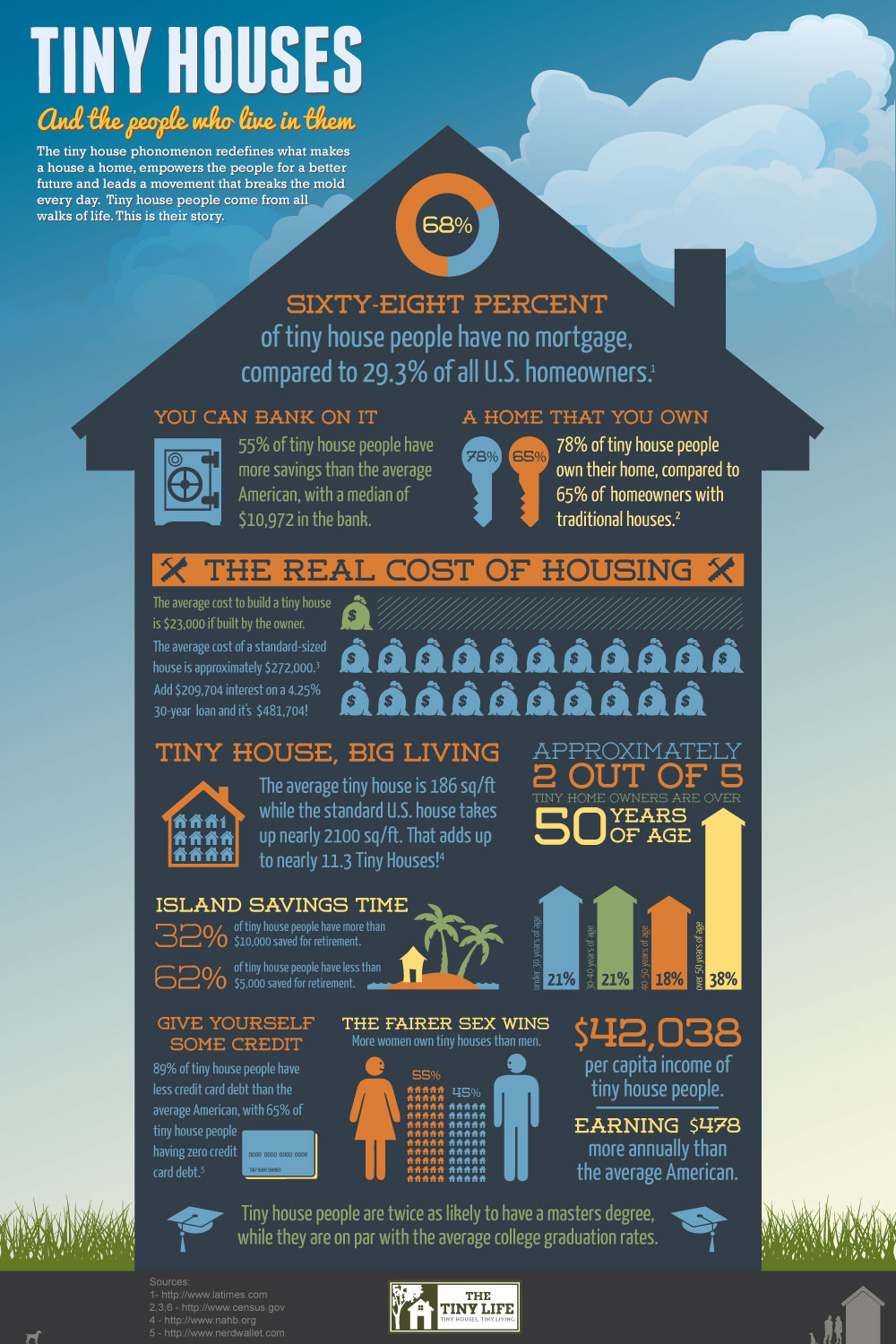
Here's
a little infographic on the subject:
Alternative
housing had always piqued our interest. Hours had gone into
researching Earthships, houseboats, cob and strawbale homes,
and yurts. Tiny houses, though, seemed immediately like the best fit
at this stage in our lives. From our urban apartment, we looked into
a number of different houses that had been built by others the world
over, on blogs, and video webseries, like Kirsten Dirsken's .
These were some of our favourite abodes:
We had
our sights set on buying plans from a local designer, not only to
help support the local economy, but also because we didn't want to be
having to make conversions from imperial to metric (what's up,
America? Metric's so easy!)--at this point, we ran into Brett
Sutherland's tiny house video tour.
Not
only was Brett local to us, his house was spectacular! The tiny house
community seems to be really hooked on gabled roofs, which we found a
bit claustrophobic. Here was a house that had its roof space opened
right up, leaving ample breathing room in the living area, and plenty
of sitting space in the loft. Brett had built the boat
he had lived on prior to returning to land, so he had experience in
smart design of small spaces. Not wanting to buy sight unseen, we
contacted Brett to see if we could visit his house.
NANCY:
I have to admit that I was a bit nervous that we'd get to his house
and find it suffocatingly narrow. Upon entering the space, however, I
fell in love. I was basically inside a boat. Having grown up on
sailboats, I instantly felt like I was home. I was ecstatic. We
bought the plans on the spot.
STEFF:
What a lot of people don't realise about tiny houses, having only
seen pictures of them, is that when you're inside the space, it feels
plenty big enough. Also, we have a really mild climate in Auckland,
and Brett's design allowed for a lot of cross breezes and
indoor-outdoor living, as well as for easy catching of rainwater. It was the
ideal plan for our build.
This
brought us to our next question: how does one actually build a tiny
house? To be honest, we had no idea. We had never built anything
before. That's not entirely true; we tried to build a wall in New
Jersey once, and we almost got divorced over it. But after some
consultation with Warren, our extremely tolerant and endlessly
valuable builder friend, we were advised to take everything one step
at a time. We made a start: we ordered the trailer.
The
trailer is the single most expensive component of the build, checking
in at approximately $10k. Putting the deposit on our custom trailer, then, was the point where this tiny house whimsy started to become a
reality. We chose to buy our trailer from Monoway, having heard good things about them. Their trailer was not only strong and nicely galvanised; they had also positioned the support bars so that our plywood flooring slotted perfectly into place (no trimming necessary, except around the wheel arches).
Also
significant for us was moving out of our apartment. We had tried to
work out a way to continue living in the city and building part-time,
but that would involve a regular commute to our build site, in
addition to continuing to pay rent.
NANCY:
Having begun our build, I'm so glad that we made the decision to move
out, if only because it makes funding the house so much less of a
stress, not having the constant threat of rent hanging over our
heads. Also, it's so nice to be able to finish a day's building and
have a shower straight away. The commute into work is no fun, as
Auckland traffic is steadily worsening, but it's a small sacrifice, when put in perspective.
STEFF: Living with family presents its challenges, but it's actually really nice to come home to an intergenerational household. Moving back in with family has immediately increased all of our support networks.
Our
last step before trailer delivery was to do a massive shopping trip for the first stage of the build.
We bought what came to look like a large heap of plywood, planks of
framing timber, and a box of fixings. A few days later, our trailer
arrived, and we began:
Levelling the trailer using cinder blocks and ground-treated timber.
The timber is there to spread the weight of the house;
it is ground-treated to prevent it from rotting in the wet conditions.
Creating a vapour barrier between the trailer and the plywood flooring
Destroying a perfectly good pair of scissors with bitumen
Drilling through ply and metal, countersinking, and driving tech screws to fix ply floor to trailer
Sanding off builders' bog, which we used to fill the countersink holes. Also, a bovine photobomb.
This week, during our ongoing process of downsizing belongings, we found this postcard that we sent ourselves from New York, in 2011. Our pertinent past selves just nailed it.
"Hey, Nancy and Steff! By the time you receive this, you'll be home!
Here's something you learned on this trip; don't forget it: so many
people, at the end of your trip
brought attention to the fact that the
trip was long, arduous, dangerous;
"how did you do it?!" they'd ask.
Here's how: you just went ahead and did it.
Remember this for goals you
might want to achieve in the future--just go ahead and do it!
Love,
Nancy and Steff"
At this time four years
ago, we were beginning the journey documented earlier in this blog.
We were 22 and 23, keen and idealistic, and pulsing with
anticipation.
Christmas post-travels 2011
Over the last four
years, our lives have shifted fairly drastically, then, in a way,
morphed into a more circular narrative: in a sense, we are revisiting
and reinventing our lives four years ago. Check it out:
In the post-van,
pre-now years, we flew home and immediately engaged in the
socially sanctioned things: Steff undertook a Bachelor of Science
degree in Ecology, Nancy began her career as a piano tuner, both of us bought
cars and dutifully paid our rent fortnightly on a charming (read:
undermaintained), overpriced one-bedroom apartment in the city.
We explored our
surroundings and tried to approach the space around us openly and
inquisitively. We were inspired by our life with less in the van, and
by the permaculture farms and homesteads we had WWOOFed at
while travelling.
We did our best to translate this model to city
living, learning about our local community, DIYing as much as we
could, and simplifying. Auckland is a relatively compact city, which
helped us to do things like collect produce directly from farmers. We
also honed some kitchen magic skills, learning to make cheese, as well as our own cleaning and personal hygiene products.
The last
four years were an experimental phase, where we dabbled in so-called
civilised society, trying on preconceived notions of adulthood for size.
During this period, we
also observed, evaluated, and refined our ideals. We reflected with
our peers and found ourselves, after a while, in a world that was in
direct conflict with what we had been told it would be. A university degree would lead to guaranteed work, we had been taught, but
all around us was evidence to the contrary: overqualified peers in
hospitality and retail, friends in overwhelming debt with no job
prospects, hordes of acquaintances abandoning their tertiary
qualifications in favour of reskilling in trades. The guidance we
were receiving from the Gospel According to Generation Baby Boomer
seemed increasingly irrelevant to our experiences, and as a group, we began to
feel an uncomfortable mélange of confusion, isolation, guilt, and
failure. The markers of success for their generation seemed now to be
little more than a direct path to crippling debt. Do not pass go, do
not collect $200.
Upon introspection, we
realised that we have been trained to find happiness in the things we
could buy, but that only leaves us suffocating in our possessions. In
any case, we can't afford all the things the billboards and bus
shelters tell us we need. We can't keep up with the releases of every
new iGadget. More importantly, we can't afford the white picket fence
house; a lot of us never expect to be able to in our lifetimes.
The question we came
to, after deliberation, was “do we even want that?” Sure, some of
our friends went to uni, got corporate jobs, and now have houses and
mortgages to keep. We totally respect them if that's what keeps them
happy, but is it what we want to make of the one shot we get at
existence? Is there another way?
In November of 2014, we
decided there is. And here is where we come full circle, from one
small space to the next. We are building a tiny house.
Let's flesh out this
picture a little: Nancy is a piano tuner, Steff is a permaculture
practitioner and educator.
Piano wrangling at the Royal Festival Hall in London, 2014
Getting all up in the terrestrial ecology
These, we are convinced, are the best jobs
in the world. We play music in a band called Tweed, and occasionally
(bonus!) get paid to do it. This is the best scantily-paid hobby in
the world. This is how we sound.
And this is how we look!
We try to create, rather than find, happiness. We don't
always succeed, but life is a work-in-progress right up until the
end, right?
We are now 25 and 26.
The last four years of our lives have been a blossoming of the ideals
we set out to explore in the van, a trial-and-error in pursuit of a
life that fits. We found conventional consumerism and the
career-centric lifestyle left us feeling a bit hollow. We're trying
something new. Are we still keen, idealistic, and pulsing with
anticipation? You bet. Stay tuned.